


Since its creation in mid-December 2009, this blog has had 500,000 page views. Here's a quick look back and our goal for 2014: to reach one million page views before the end of the year. Let's take a look at how this blog has evolved 😉
Half a million page views: that's the incredible number of visits to this blog since it was created in mid-December 2009. At the end of this first fortnight, it had 135 page views!

But thanks to your complicity and your incredible loyalty, this blog exploded in the following years. In fact, the number of page views has more than doubled every year, as you can see from this first graph:

If the number of visits doesn't fall, the number of page views for January 2014 should exceed 40,000! And I should reach 500,000 page views for 2014, which would bring the total to one million...
But a blog isn't just about page views, it's also about countless exchanges through thousands of comments, dozens of emails and messages through the Contact page.
It's this conversation over the years that interests and enriches me.
Two phenomena explain the rate of page views:
- the mass of items The blog currently has almost 400 posts
- some " featured articles "which are "pulling" up visitor numbers
Feature articles, the ones that drive traffic upwards
The most popular articles are the following:
- 5 steps to effective studying
- How do I choose my mindmapping software?
- XMind 2.0 is here! And in French, please!
- Job interview: THE question that makes the difference
- Howard Gardner's multiple intelligences
The graph below shows the distribution and number of views of these articles:
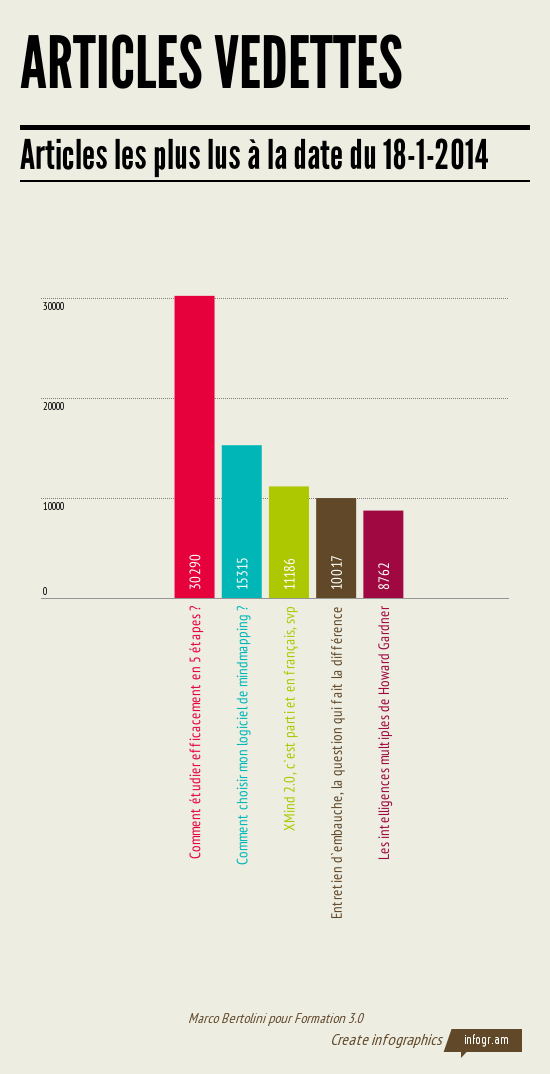
A phenomenon due to long tail distribution
The number of visitors to the blog therefore corresponds perfectly to the " long tail theory "or Long Tail Theory "in English. A theory that holds true in many fields.
Here, it illustrates the fact that the number of visits is due to both a minority of highly-read articles and a majority of articles that are seen far less. But the sheer volume of these articles is pushing up the statistics.

In fact, it's a " Pareto's law In this case, the "star" articles contribute around 20 % of traffic, while the mass of low-impact articles - "weak" keywords - contribute 80 % of visits.
This long tail theory was first formulated by Chris Anderson in an article in Wired to illustrate the difference between on-site sales and online sales, with the latter relying mainly on mass-market, low-demand items.
The five star articles have keywords that are well positioned in the Google results pages (the famous SERPs). If you type " How to study "in Google, there's a good chance that my article " 5 steps to effective studying "Either at the top of the list on the first page (the position changes over time, sometimes first, sometimes second or third)...
The same goes for " how to choose mindmapping software "where the corresponding article also appears at the top of the front page...
The sources or referrers of our visits
Where do these visits come from? The primary sources of these visits are undoubtedly the search engines. Statistics for the past year show that 125,252 visits were due to search engines and mainly Google. (Statistics as at 20-01-2014 for the previous 365 days).
The other visits are spread across a multitude of sites and media/social networks, with the most popular being.., Scoop it and Facebookas shown in the graph below:

Objectives for 2014: more education, training and visual thinking
Even though social media and SEO techniques can multiply the opportunities to be read, the important thing for me - and for you - is the content of the articles.
I will, of course, continue to talk about mindmapping andproductivity tools - For example, I plan to update the article " How to choose my mindmapping software" taking into account recent versions of software such as XMind 2013, MindMeister 9 or iMindMap 7 Chameleon. But also tests of other applications such as Mind42 which I mentioned just recently.
But I would also like to explore other areas, such as teaching. I get a lot of feedback or requests about tools for studying at university, for example. I'd also like to rework the online trainingrecreate training courses entirely in e-learning. I'm also interested in MOOCs - I take part in several of them as a student, but I'm keen to move to the other side of the screen and I've got a few ideas I'd like to try out...
And finally, I'd also like to delve into other areas of the visual thinking that mindmapping. I'm not denying the latter, of course: it's a fabulous tool that has given me a lot and will no doubt continue to do so. But I also want to explore other areas such as concept mapping and explore theargument mapping or argument maps which is still not very well known in French-speaking countries and probably deserves more publicity (in the good sense of the word - don't think I'm going to bombard you with advertising from today onwards).
I'm also thinking of introducing interviews with students - studying abroad, for example - articles on studying outside the French-speaking world, interviews with professionals in various fields, and so on.
Don't hesitate to make suggestions, or to tell me what you want or want to know. I'll be delighted to try and answer them, alone or with you 😉
I hope you'll follow me into these new areas as you have so far.
Thank you all for your fantastic loyalty,
Marco.
Did you like this article? Subscribe to my newsletter and never miss another article or event!


 English (UK)
  Français
  Italiano
  Español
  Português
So what do you think? Tell us all about it!